
Custom 3D-Printed Orthotics vs. Retail Non-Prescribed Inserts: Which Is Saving Your Feet?
If you’ve ever felt that nagging ache in your arches after a long day, you’ve likely faced the "pharmacy aisle dilemma." On one hand, you have the squishy, tempting convenience of retail inserts. On the other, the high-tech, clinical, medical grade custom 3D-printed orthotic.
As a podiatry expert, I see the fallout of this choice every day. While one offers a "quick fix" for comfort, the other is a precision-engineered medical device. Let’s break down the science of what’s actually happening under your feet.
The Comparison at a Glance
For those looking for the "bottom line," this table compares the clinical reality of both options over a standard lifecycle.
Feature | Retail Gel Inserts | Custom 3D-Printed Orthotics |
Durability | 6-12 Months (Compression set occurs quickly) | 3–10 Years (High-grade polymers) |
Biomechanical Correction | Mild-Moderate (Generic) | High (Precision support) |
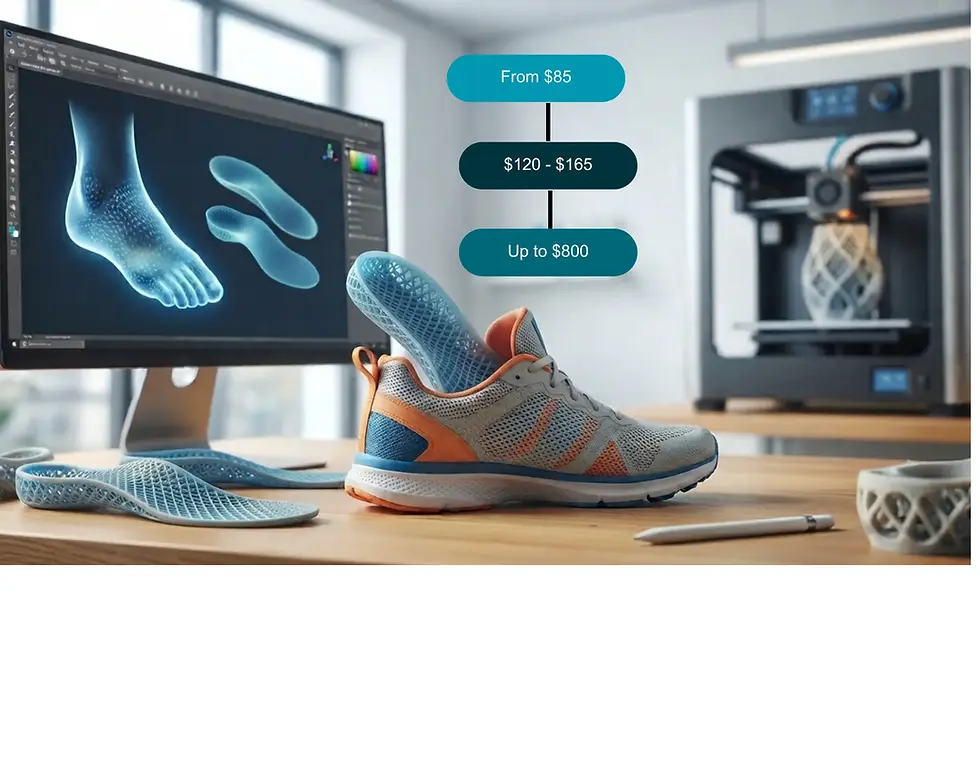
Cost-per-year | $80 – $100 (Frequent replacements) | $100 – $150 (Amortized over lifespan) |
Ideal Foot Type | Neutral feet needing mild support | Flat feet, high arches, chronic pain, foot deformity |
The 3D-Printing Revolution: Variable Density
The biggest "game changer" in modern podiatry isn't just the fit—it’s the variable density made possible by 3D printing.
Traditional orthotics often were a set formula - a rigid piece of plastic with foam glued on top. However, 3D printing (specifically Multi Jet Fusion or SLS technology) allows us to prescribe the orthotic down to a thickness of 1mm.

Why this matters: We can design a single orthotic that is stiff and supportive under your arch, yet flexible and "springy" under your big toe joint. This mimics the natural movement of the foot while providing structural correction exactly where you need it.
Retail inserts, by contrast, are uniform. They do provide some support but often don't reduce tissue stress to an ankle or offload a painful neuroma.
Why Retail Inserts Often Fail
Retail inserts are the "one-size-fits-most" of the foot world. While they feel great initially (the "marshmallow effect"), they can lack structural integrity.
The Bottom-Out Effect: Foams and gels compress under body weight. Once it bottoms out, you are essentially walking on the same hard surface that caused the pain in the first place.
Lack of Control: If your foot over-pronates (rolls inward), a soft gel insert will simply roll with it, offering limited resistance to the sensitive tissues in your foot or lower limb.
The Verdict: Investment vs. Expense
While the upfront cost of custom 3D-printed orthotics is higher, they are a long-term investment in your musculoskeletal health. By aligning the feet, you aren't just treating foot pain—you're protecting your knees, hips, and lower back from the "ground-up" effects of poor biomechanics.
Ready to stop guessing and start correcting? Contact us to discuss your needs with one of our professional Podiatrists.
If you require assistance we are here to help. Schedule an Appointment at our Parkwood Clinic



Comments